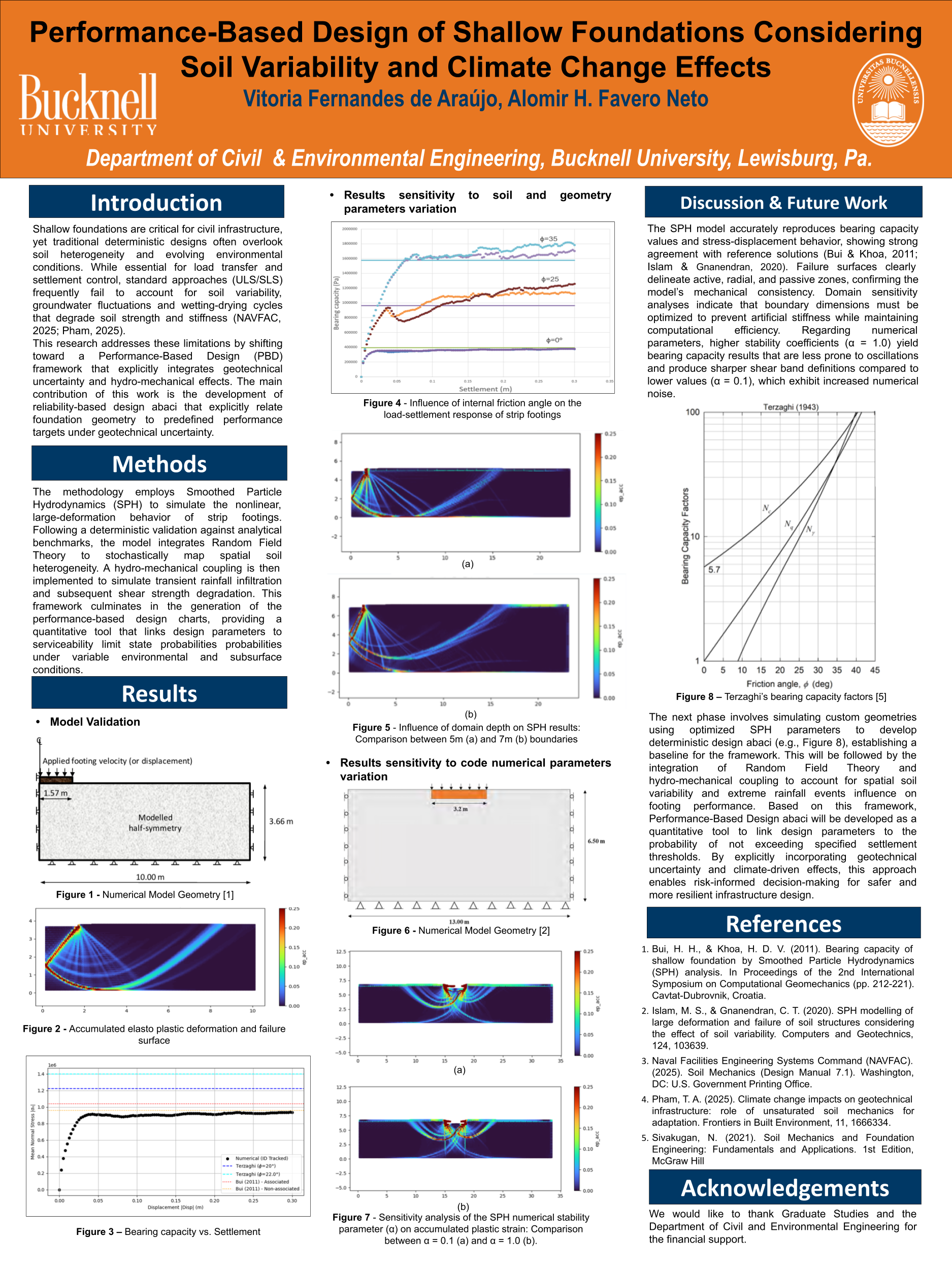
Performance-Based Design of Shallow Foundations Considering Soil Variability and Climate Change Effects
Author:
Vitoria Fernandes de Araujo (Graduate Student)Co-Authors:
Faculty Mentor(s):
Alomir H Favero Neto, Civil & Environmental EngineeringFunding Source:
Department of Civil & Environmental EngineeringAbstract
Traditional geotechnical design relies on deterministic methods and prescriptive safety factors that often fail to account for inherent soil heterogeneity and dynamic environmental changes. This research proposes a shift towards a Performance-Based Design (PBD) framework for strip footings, by integrating stochastic modeling with climate-driven hydro-mechanical coupling. The methodology utilizes Smoothed Particle Hydrodynamics (SPH), an advanced mesh-free numerical approach capable of modeling highly nonlinear behavior and large-deformation processes. The framework is developed in three phases: (1) establishing a deterministic baseline validated against classical analytical benchmarks; (2) incorporating Random Field Theory to quantify spatial soil variability and include it on settlement analysis; and (3), including hydro-mechanical coupling to simulate soil behavior under transient rainfall infiltration. The hydro-mechanical coupling is necessary to evaluate wetting-induced collapse and the degradation of shear strength and stiffness caused by extreme rainfall events. The primary contribution of the work is a comprehensive set of reliability-based design abaci that will enable practicing engineers to directly correlate foundation geometry with specified probabilities of exceeding serviceability limit state thresholds related to settlement, based on stochastic distributions of soil properties and evolving rainfall pattern likelihoods. By explicitly integrating geotechnical uncertainty and climate resilience, this work provides a quantitative tool for risk-informed decision-making, ensuring that shallow foundation systems remain functional and safe under increasingly variable environmental and subsurface conditions.