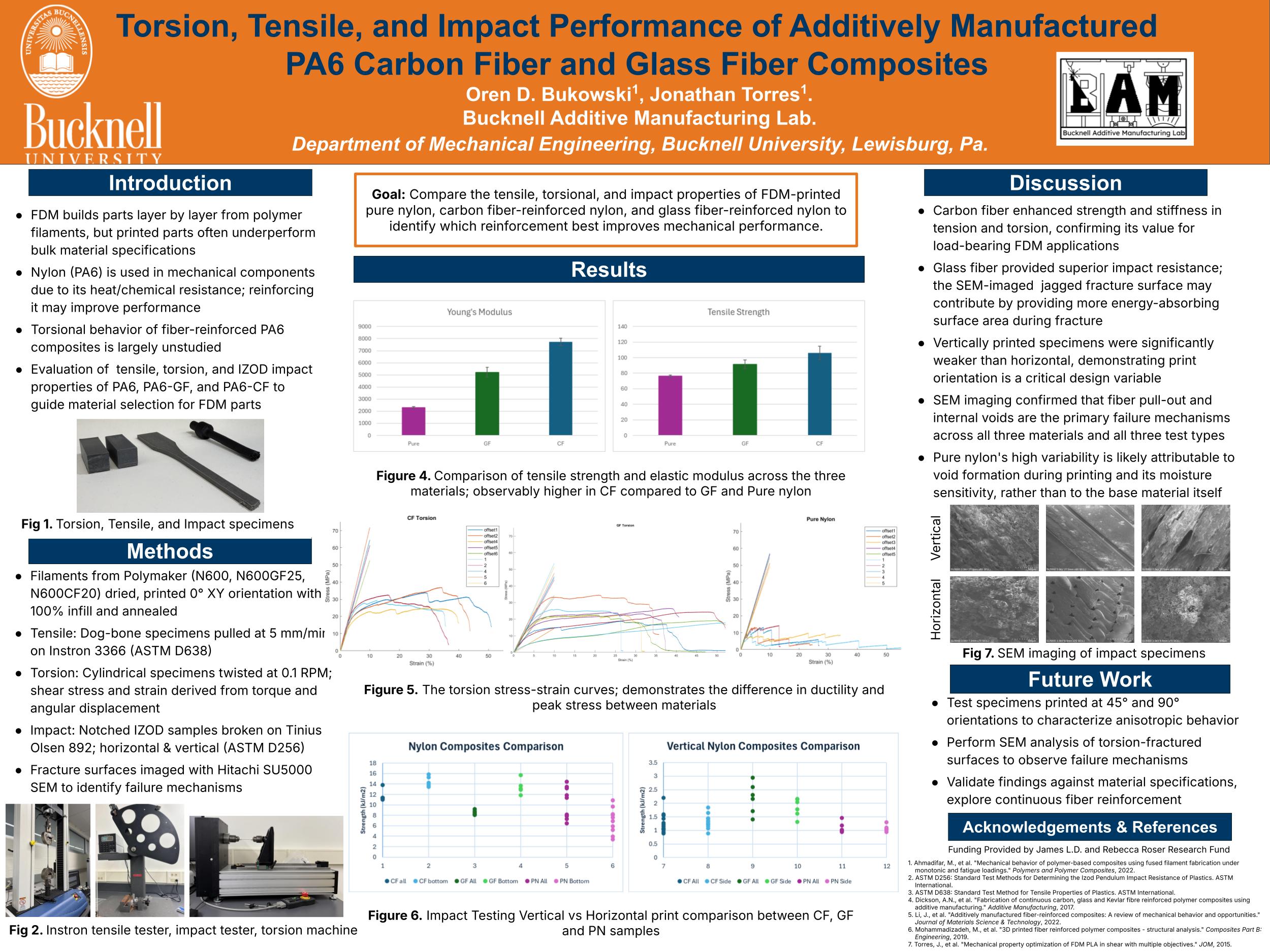
Torsion, Tensile, and Impact Performance of Additively Manufactured PA6 Carbon Fiber and Glass Fiber Composites
Author:
Oren Bukowski ’26Co-Authors:
Faculty Mentor(s):
Jonathan, Torres, Mechanical EngineeringFunding Source:
James L.D. and Rebecca Roser Research FundAbstract
Additive manufacturing (AM) using fused deposition modeling (FDM) is increasingly applied to fiber-reinforced polymers, yet comprehensive experimental evaluation of their mechanical behavior remains limited. This study expands prior work on carbon-fiber (CF) and glass-fiber (GF) reinforced nylon by investigating the influence of print parameters, annealing conditions, and filament type on the tensile, fatigue, and torsional performance of reinforced and pure nylon specimens. Test coupons were iteratively fabricated using a dual-nozzle FDM system, with process refinements implemented to address support-material adhesion, filament moisture, and print variability. Mechanical properties, including tensile strength, Young’s modulus, ductility, and torsional resistance, were extracted through standardized testing and custom data-analysis methods. Results indicate that appropriate annealing improves consistency in CF and GF composites, though GF specimens exhibited higher print failure rates. Pure nylon demonstrated high ductility and irregular fracture behavior, likely influenced by moisture absorption and thermal history. Measured elastic moduli were generally lower than manufacturer specifications, suggesting sensitivity to testing conditions and strain measurement methods. Torsional testing showed the greatest reproducibility in pure nylon, while chopped carbon-fiber reinforcement provided the strongest resistance to torsional deformation and fracture. Overall, significant variability across all materials highlights the strong dependence of mechanical performance on processing conditions. These findings contribute to improved understanding and optimization of FDM-printed nylon composites for structural applications.