Numerical Analysis of Vane Shear Test
Author:
Gustavo Oliveira (Graduate Student)Co-Authors:
Faculty Mentor(s):
Alomir, Favero, Civil & Environmental Engineering DepartmentFunding Source:
Graduate StudiesAbstract
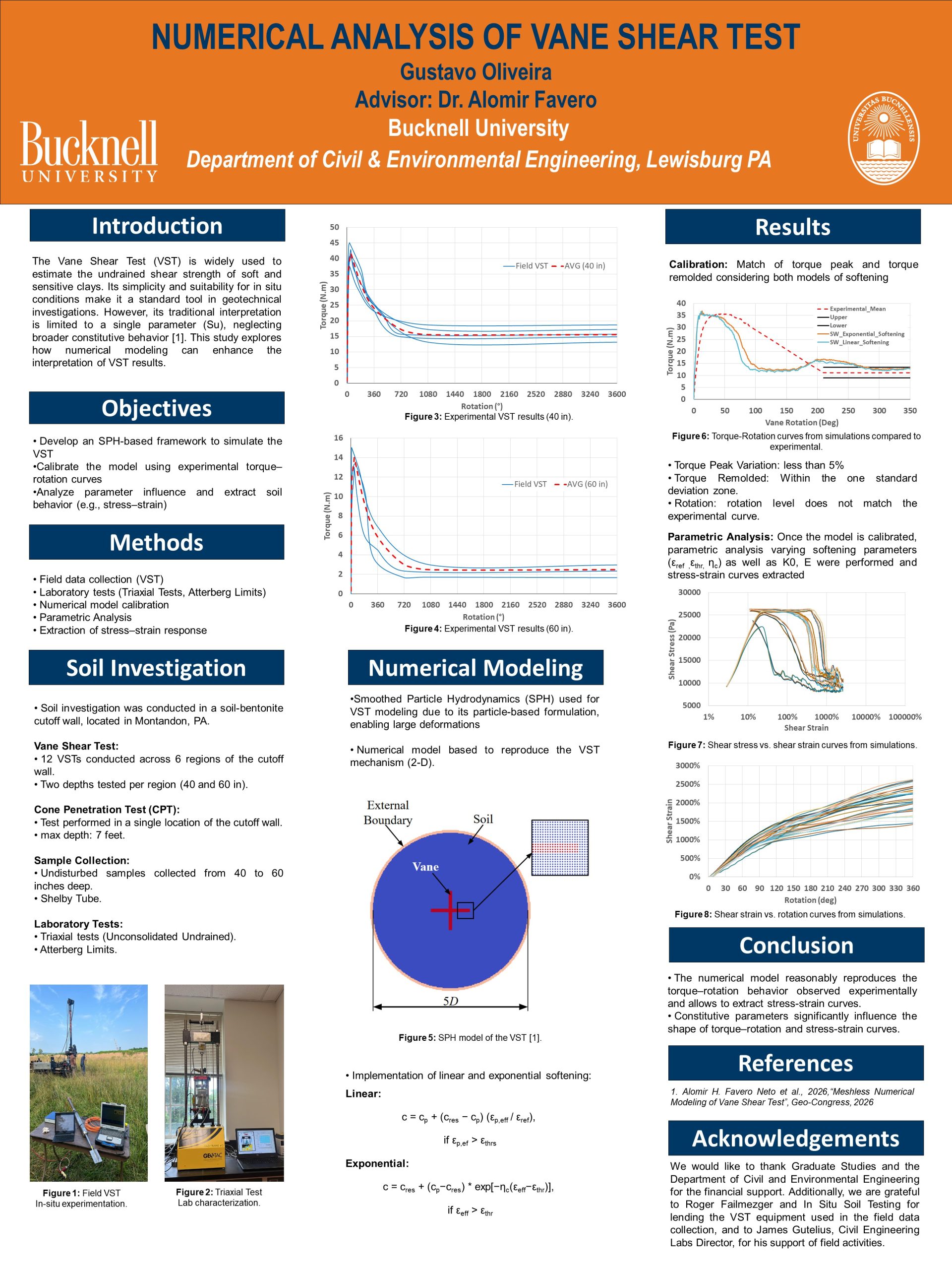
The Vane Shear Test (VST) is widely used in geotechnical engineering to determine the undrained shear strength of soft and sensitive clays due to its simplicity, low cost, and suitability for in situ conditions where high-quality sampling is challenging. Despite its extensive application in foundation design and stability analyses, its traditional interpretation is limited to the determination of undrained shear strength. However, there is potential for the test to provide further insights into the soil’s constitutive behavior. Hence, this research explores the use of numerical models validated using experimental results to extract more information from the VST. To do so, we used the Smoothed Particle Hydrodynamics (SPH) method, to model the VST. To validate and calibrate the numerical framework, an experimental program including field VSTs, Cone Penetration Tests (CPT), and triaxial tests was conducted to characterize soil behavior at a local site, and obtain constitutive parameters for the numerical model. The model calibration was then achieved by tuning input numerical parameters to match simulated VST torque–rotation curves with experimental results. Subsequently, a parametric study was conducted to evaluate the influence of a set of constitutive parameters on simulation behavior to extract further information from the test, such as stress-strain relationships with torque and rotation, and in situ lateral earth pressure coefficient (K0). The work contributes to the improvement of the interpretation of VST data and proposes new procedures and correlations to obtain additional constitutive parameters of the soil from the test.