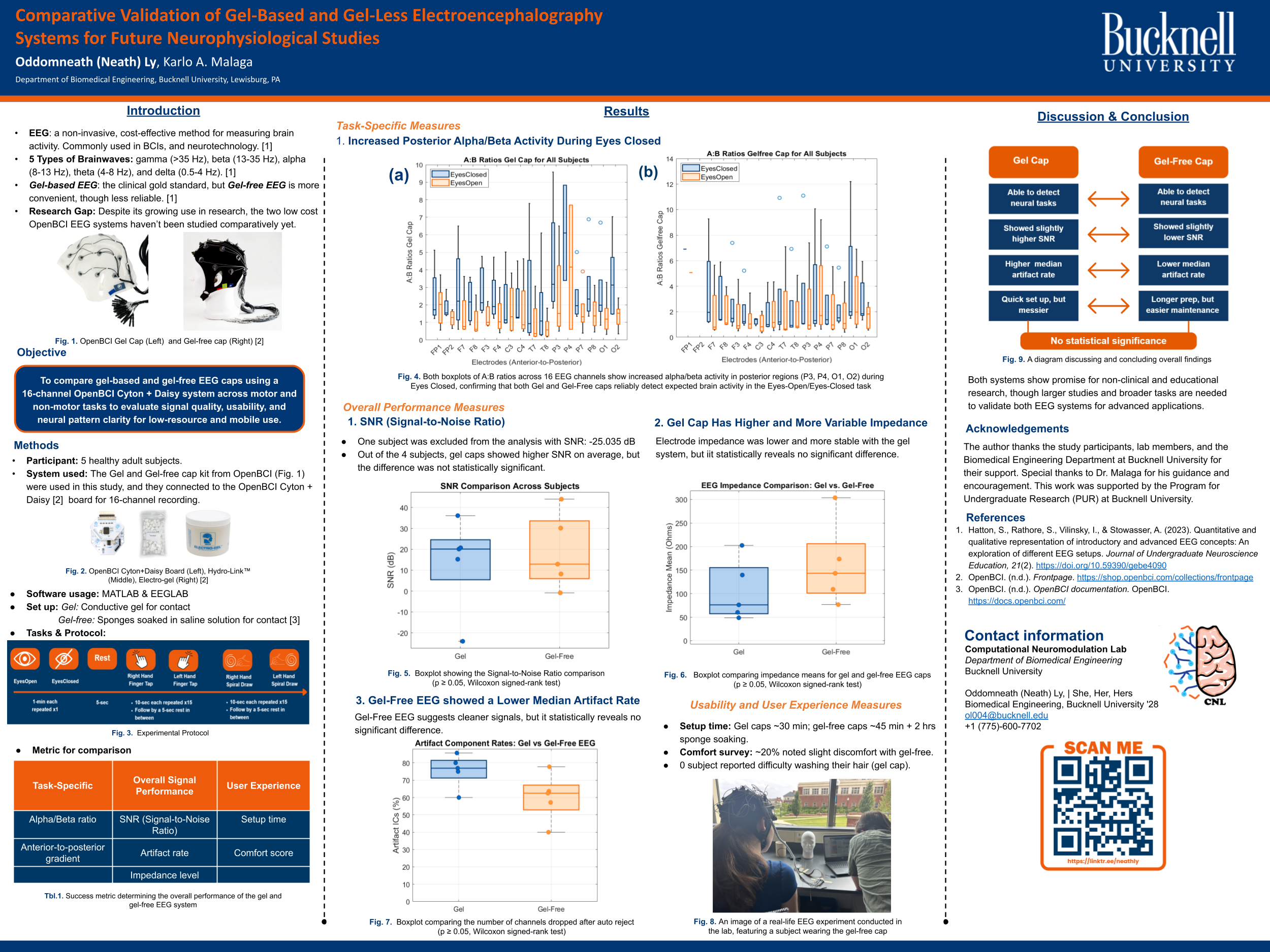
Comparative Validation of Gel-Based and Gel-Less Electroencephalography Systems for Future Neurophysiological Studies
Author:
ODDOMNEATH LY ’28Co-Authors:
Faculty Mentor(s):
Karlo A. Malaga, Biomedical EngineeringFunding Source:
Program for Undergraduate Research ("PUR")Abstract
This study compares gel-based and gel-free electroencephalography (EEG) systems
using the OpenBCI Cyton + Daisy board, a low-cost, open-source platform increasingly utilized in neurotechnology research. While gel electrodes are known for superior signal quality, they require extensive setup and can cause user discomfort. Gel-free systems offer greater convenience, but may introduce higher noise and signal instability. Prior studies have assessed these trade-offs using clinical-grade hardware, but few have evaluated performance specifically within OpenBCI systems.
Five healthy participants completed EEG tasks including resting-state (eyes-open/closed) and motor tasks (finger tapping, spiral drawing) using both caps. Signal quality was evaluated through alpha-to-beta (A:B) ratios, signal-to-noise ratio (SNR), impedance levels, and independent component analysis (ICA) -derived artifact proportions. Usability was assessed through setup time, impedance stability, and a user comfort survey.
The gel-based system showed stronger and more consistent A:B elevation during eyes-closed conditions, though group differences were not statistically significant. SNR values were similar between systems (gel: 13.63 ± 22.46 dB; gel-free: 19.22 ± 17.55 dB), with one gel outlier likely due to setup error. Artifact proportions were higher in gel data, while impedance was lower and more stable compared to gel-free. Survey results indicated similar comfort, with minimal post-use discomfort or cleanup issues.
Despite a small sample size, both systems effectively captured relevant neural signals.
Gel-based systems showed marginally greater consistency, while gel-free systems offered setup advantages. These findings provide early insights for selecting EEG systems based on specific research needs. Future work will explore additional metrics such as spectral stability and topographical reliability across broader populations.