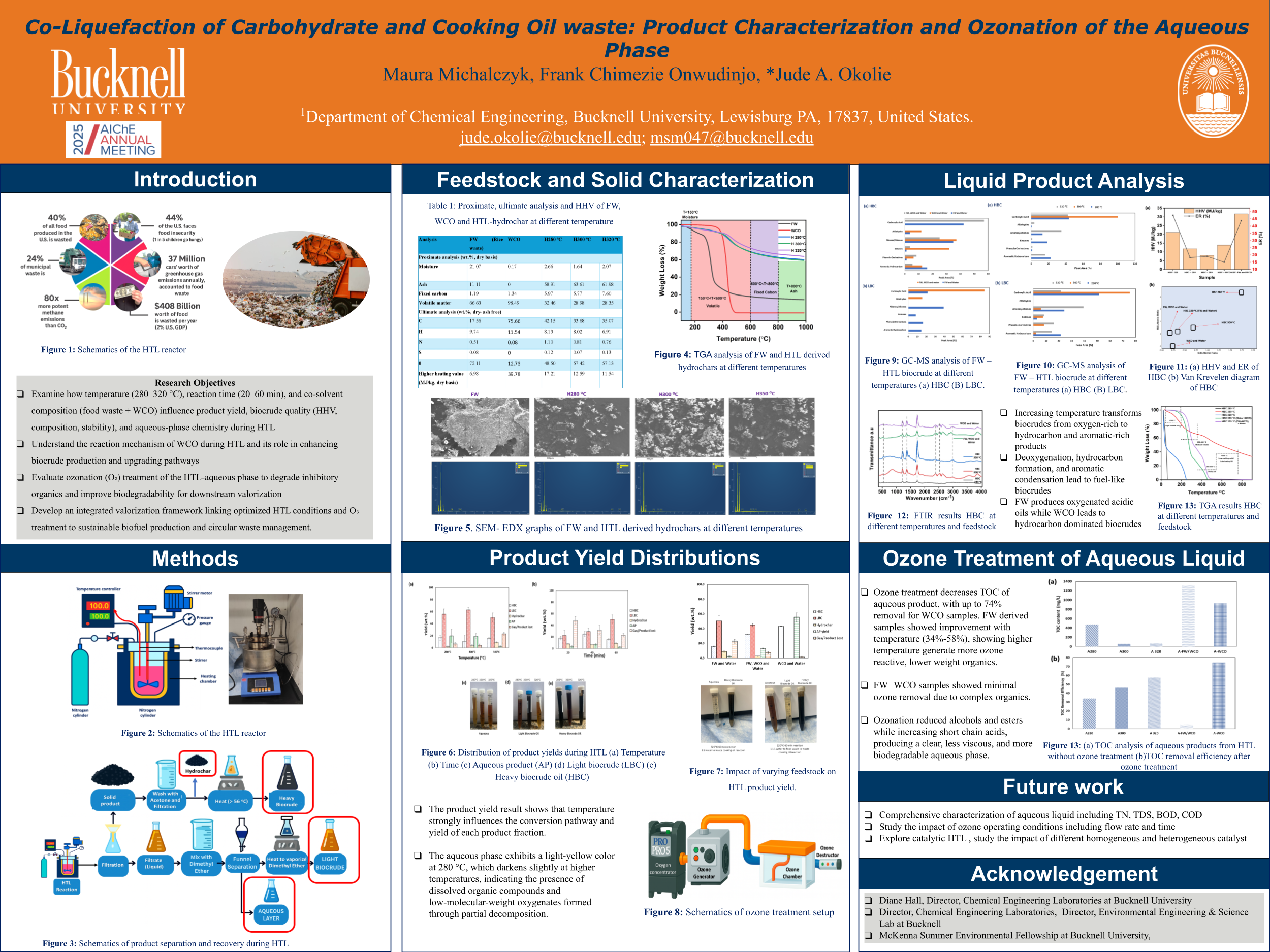
Co-Liquefaction of Carbohydrate and Cooking Oil waste: Product Characterization and Ozonation of the Aqueous Phase
Author:
Maura Michalczyk ’28Co-Authors:
Frank Chimezie Onwudinjo, Jude A. OkolieFaculty Mentor(s):
Jude Okolie, Chemical EngineeringFunding Source:
McKenna Environmental FellowshipAbstract
Food waste (FW) and waste cooking oil (WCO) make up a large portion of organic waste and are disposed of in ways that create environmental challenges. However, this waste can serve as valuable sources of sustainable energy and materials. This study investigates the hydrothermal liquefaction (HTL) of carbohydrate-rich FW and WCO to evaluate potential to produce biocrude as a sustainable aviation fuel (SAF) precursor, while examining HTL byproducts and post-treatment strategies. HTL experiments were conducted at temperatures between 280 and 320 °C and reaction times of 20–60 minutes with varying ratios of WCO and FW. Biocrude was extracted using diethyl-ether and acetone. The study results indicate reaction temperature strongly influenced product yields and conversion pathways. Increasing the temperature from 280 to 300 °C during FW liquefaction increased biocrude yield from 55.7 to 62.7 wt.%, while increasing the temperature to 320 °C reduced yield to 50.5 wt.%. Extending the reaction time to 60 minutes reduced byproduct formation while maintaining moderate biocrude yields.
Co-liquefaction of FW and WCO at a 1:1 ratio and 320 °C for 60 minutes produced the highest biocrude yield (77.1 wt.%). Biocrude composition varied with HTL severity and feedstock, with lower temperatures favoring oxygenated compounds and higher temperatures increasing hydrocarbons and aromatics. The addition of WCO altered the aqueous phase composition, and subsequent ozone treatment further oxidized and simplified organic species, improving suitability for downstream treatment.
Overall, this study demonstrates a promising pathway for food waste valorization with environmental and resource recovery benefits.