Establishing the Effectiveness of the OpenBCI EEG System in Identifying Physiological Markers of Healthy Brains
Author:
Quinn Smith ’27Co-Authors:
Dr. Karlo MalagaFaculty Mentor(s):
Dr. Karlo Malaga, Department of Biomedical EngineeringFunding Source:
Neuroscience & Human Health, Gary A. and Sandra K. Sojka Fund for Research, Teaching and Scholarship in Developmental DisabilitiesAbstract
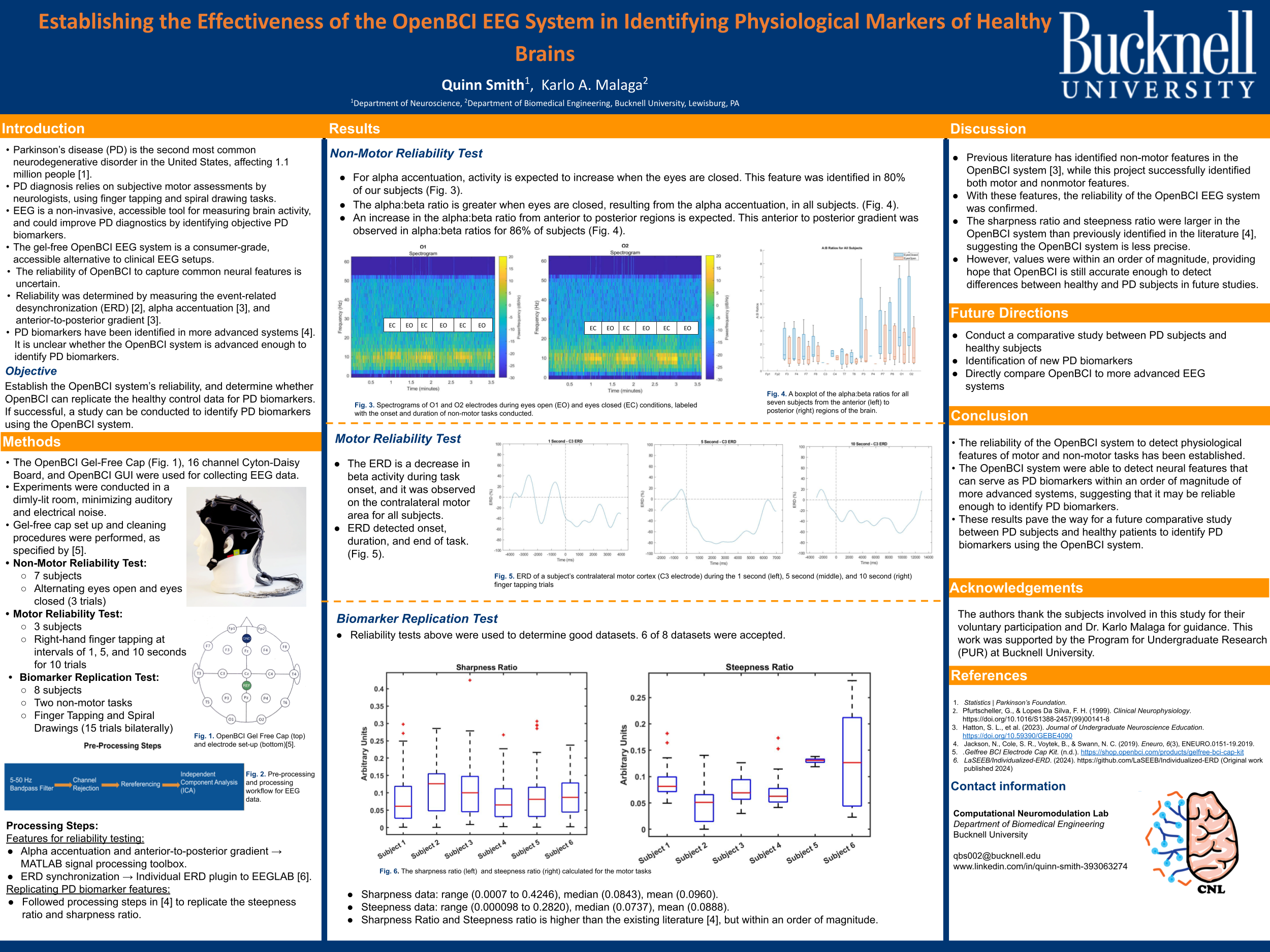
Parkinson disease (PD) is the second most common neurodegenerative disorder in the United States, affecting 1.1 million people. However, ~20% of PD patients are misdiagnosed because diagnosis often relies on subjective motor assessments by doctors. Electroencephalography (EEG) is a non-invasive, accessible tool that records neural activity using electrodes placed on the scalp, and can be used to improve diagnostics with objective neural biomarkers of PD. The cognitive neuromodulation lab bought the OpenBCI EEG system last spring, and this project sought to identify the reliability of the system. Three experiments were conducted with healthy volunteers. The data for each experiment was preprocessed using EEGLAB to isolate neural data from electrical noise. Then, MATLAB’s signal processing toolbox was used to extract the neural features. The first two experiments looked for robust neurological biomarkers of health data identified with more advanced EEG systems. With subjects alternating between eyes open and eyes closed states in the first experiment and performing thirty trials of finger tapping in the second experiment, two nonmotor biomarkers and one motor biomarker were successfully identified. The third experiment had patients perform finger tapping and spiral drawing, bilaterally, replicating motor tasks in PD assessments. With this data, three biomarkers known to differ between PD and healthy subjects were identified in this healthy cohort, consistent with the data in the literature. Having identified these biomarkers, the reliability of the OpenBCI system is verified and a comparative study between healthy subjects and PD patients will be conducted to identify novel PD biomarkers.