Environmental Degradation and Food Systems in Ghana: Gold Mining & Synthetic Pesticides
Author:
Da’Mirah Vinson ’26Co-Authors:
Faculty Mentor(s):
Apollonya Porcelli, SociologyJanet Adomako, Geography
Funding Source:
Douglas K. Candland Undergraduate Research Fund; Tom Greeves FundAbstract
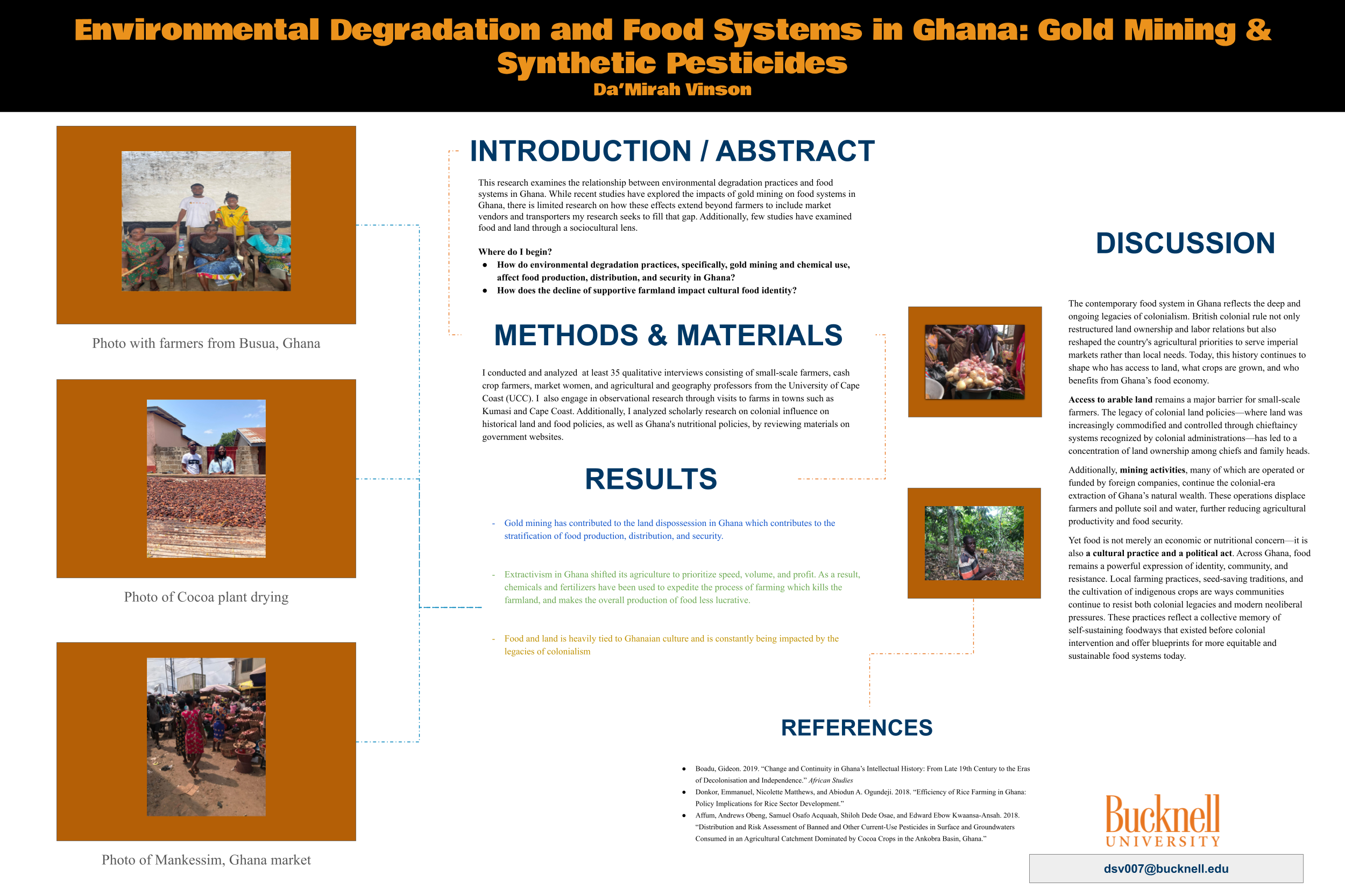
This research examines the relationship between environmental degradation and food systems in Ghana. While existing studies explore the effects of gold mining on farmers (Gilbert and Albert 2016; Agariga 2021; Kwang and Blagogie 2025), little attention has been given to how these impacts extend to market vendors and transporters. Even fewer studies analyze food and land through a sociocultural lens. My research addresses these gaps by asking: How do environmental degradation practices—specifically gold mining and chemical use—affect food production, distribution, and security in Ghana? And how does the decline of arable land reshape cultural food identity (Parasecoli 2014)? To explore these questions, I used qualitative interviews, policy analysis, and a review of existing scholarship. Over three months, I conducted 35 semi-structured interviews (20–60 minutes each) with small-scale farmers, cash crop farmers, and market vendors in Cape Coast, Agona, Kumasi, Obuasi, Busia, Tarkwa, Ho, and Mankessim. This approach centered local perspectives while capturing the broader structural context (Gyan and Mfoafo-M’Carthy 2021; Thow et al. 2021; Ahmed et al. 2021). Findings indicate that while mining has long been part of Ghanaian society, its mechanization under British colonial rule intensified environmental harm, disrupting food production and distribution and deepening food insecurity. Those in lower economic tiers—farmers, Indigenous miners, and non-mining community members—bear the greatest burdens. Chemical use reflects unequal access to quality inputs and pressures to maximize cash crop yields, degrading land and risking health. Participants also expressed concern over cultural loss as farmland diminishes, though some resist by revitalizing traditional agricultural practices.