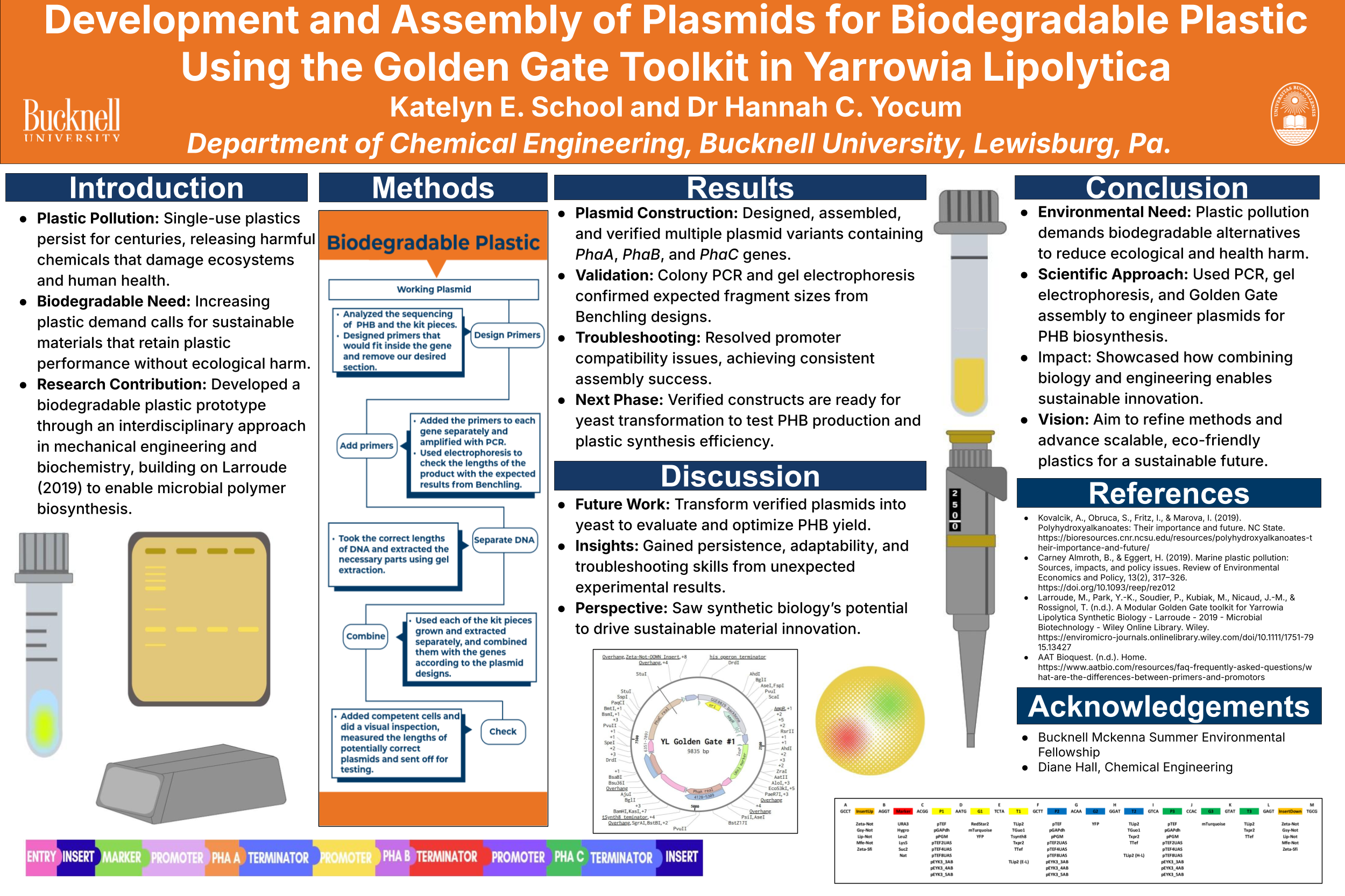
Development and Assembly of Plasmids for Biodegradable Plastic Using the Golden Gate Toolkit in Yarrowia Lipolytica
Author:
Katelyn School ’28
Co-Authors:
Faculty Mentor(s):
Dr. Hannah Yocum, Chemical Engineering
Funding Source:
McKenna Summer Environmental Fellowship
Abstract
Reliance on single-use plastics continues to harm the environment as toxic chemicals leach into waterways, threatening plants, animals, and ecosystems. To help address this issue, I worked to develop a biodegradable plastic alternative that could reduce environmental damage while maintaining similar performance properties. My objective was to design and compare several plasmids to determine which would be most effective for producing biodegradable plastics. Using Benchling, I selected compatible components from the Yarrowia lipolytica Golden Gate Toolkit and combined them with PHB genes. I chose a diverse set of genetic parts to increase the likelihood that at least one plasmid design would successfully produce the target polymer. To guide my selections, I referenced the publication “A Modular Golden Gate Toolkit for Yarrowia lipolytica Synthetic Biology.” After finalizing the designs, I assembled the plasmids using Golden Gate assembly, which allows multiple DNA fragments to be joined in a single reaction. Each plasmid included inserts from three genes—PhaA, PhaB, and PhaC—which encode enzymes required for synthesizing polyhydroxybutyrate (PHB), a biodegradable polymer that can serve as an alternative to conventional plastics. I analyzed gene sequences in Benchling and designed forward and reverse primers for each insert. The genes were amplified using PCR and verified through gel electrophoresis. After several iterations, the plasmids were successfully assembled, transformed into competent cells, and confirmed through colony PCR to match the expected DNA lengths.