A Conceptual Approach to Estimate the Environment Impact of Electric Aircraft in the U.S. NAS
Author:
Kade Davidheiser ’28Co-Authors:
Faculty Mentor(s):
Greg O'neillFunding Source:
College of EngineeringAbstract
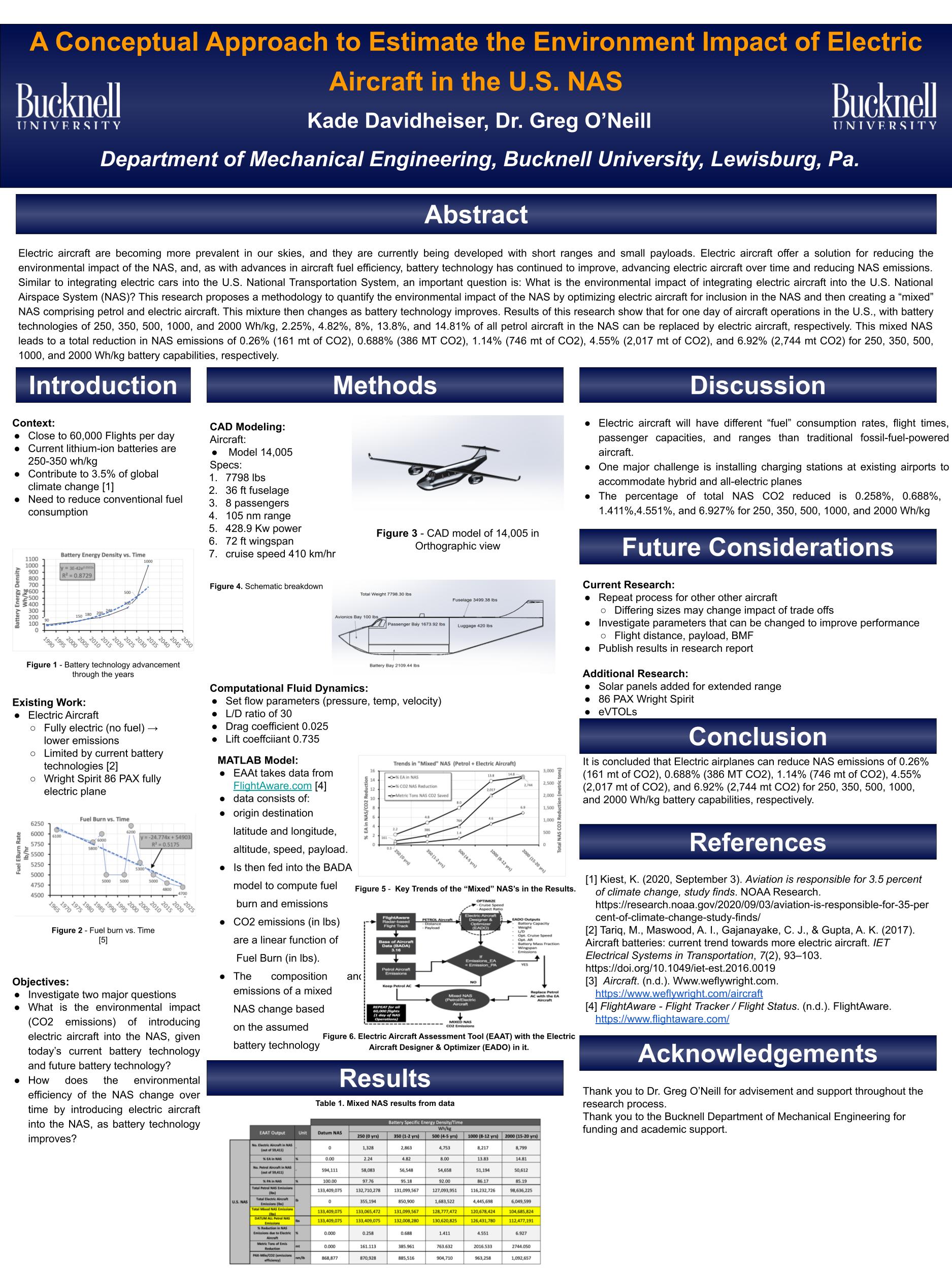
Electric aircraft are becoming more prevalent in our skies, and they are currently being developed with short ranges and small payloads. Electric aircraft offer a solution for reducing the environmental impact of the NAS, and, as with advances in aircraft fuel efficiency, battery technology has continued to improve, advancing electric aircraft over time and reducing NAS emissions. Similar to integrating electric cars into the U.S. National Transportation System, an important question is: What is the environmental impact of integrating electric aircraft into the U.S. National Airspace System (NAS)? This research proposes a methodology to quantify the environmental impact of the NAS by optimizing electric aircraft for inclusion in the NAS and then creating a “mixed” NAS comprising petrol and electric aircraft. This mixture then changes as battery technology improves. Results of this research show that for one day of aircraft operations in the U.S., with battery technologies of 250, 350, 500, 1000, and 2000 Wh/kg, 2.25%, 4.82%, 8%, 13.8%, and 14.81% of all petrol aircraft in the NAS can be replaced by electric aircraft, respectively. This mixed NAS leads to a total reduction in NAS emissions of 0.26% (161 mt of CO2), 0.688% (386 MT CO2), 1.14% (746 mt of CO2), 4.55% (2,017 mt of CO2), and 6.92% (2,744 mt CO2) for 250, 350, 500, 1000, and 2000 Wh/kg battery capabilities, respectively.